- Home
- ESG Management
- Environmental
- Environmental Management
ESG Management
Environmental
SK Ecoengineering has established and implemented an environmental management policy to
systematically promote environmental management across all business operations. To ensure effective
environmental management and performance monitoring, we operate and manage all domestic and overseas
sites based on the ISO 14001 international environmental management system standard, striving for
regulatory compliance, prevention of environmental accidents, and minimizing negative environmental
impacts.
SK Ecoengineering promotes environmental management under the responsibility of the CEO, with the
environmental team overseeing activities and performance. At sites with designated environmental
managers, efforts are made to integrate environmental management practices into operations.
As a company leading a sustainable future, SK ecoengineering recognizes the environment as a core value. Its environmental policy is dedicated to minimizing environmental impact across all business activities and contribute to sustainable development.
- We fully disclose our environmental management performance and contribute to social development through active communication with various stakeholders.
- We establish and apply rigorous in-house standards to comply with domestic and international environmental legislations and regulations.
- We minimize environmental risks by discovering, implementing, and disseminating eco-friendly site management plans.
-
We take the lead in achieving Net Zero and circular economy and secure global leadership
through the voluntary participation and practice of all members in environmental management activities to respond to climate change. - We contribute to the continuous growth and development of the company through innovation and our advantageous environmental management system.
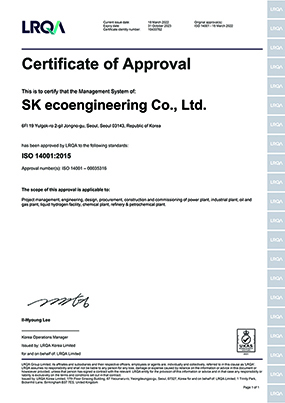 ISO 14001 certificate
SK Ecoengineering conducts systematic environmental audits to achieve zero major environmental regulation violations and continues efforts to enhance waste recycling rate management.
| Category | Unit | 2022 | 2023 |
|---|---|---|---|
| Major Environmental Regulation Violations | Cases | 0 | 0 |
| Waste Recycling Rate | % | 94.7 | 95.1 |
- Major Environmental Regulation Violations: Severe violations of environmental laws, such as unauthorized discharge or leakage of pollutants, false reporting, or fraudulent submissions, with significant societal impact (cases involving fines of KRW 10 million / USD 10,000 or more)
- Scope of Waste: Industrial waste (e.g., construction waste) and hazardous waste
We conduct regular and ad-hoc environmental audits to prevent risks and improve operational efficiency. We carry out customized audits for each site according to its size and operation process, and for sites where vulnerabilities are identified, we develop remediation plans to promote environmental management. Various supports are also provided for environmental management system implementation and environmental training at sites, and special audits are conducted during the heavy rainy season to prevent risks to vulnerable areas and facilities in response to the increasing severity of natural disasters such as localized torrential rains and typhoons. We make sure the findings of environmental audits are completely addressed at each site and tracked for recurrence prevention. Findings from environmental audits are addressed at each site through corrective actions, with continuous monitoring to prevent recurrence. Since 2023, SK Ecoengineering has enhanced work efficiency in site environmental management by integrating our DT system, S.CON (Smart Construction Platform).
Managing Environmental NoncomplianceWe assign designated environmental supervisors to oversee the entire project process from site construction to completion, and check items such as air, waste, noise, vibration, and water quality using a standard environmental compliance checklist that covers project licensing, operation, and measures for prevention and containment facilities. We also strive to comply with environmental laws and regulations by providing a package of required documents as part of an on-site environmental management standard guide, and by focusing on six nonconformance areas for key processes.
1) Penalties over KRW 10 million
| Category | Major Nonconformity | Minor Nonconformity |
|---|---|---|
| Turbid Water Discharge |
|
|
| Wastewater Discharge |
|
|
| Waste Disposal Violations |
|
|
| Fugitive Dust(Transport) |
|
|
| Fugitive Dust (Stockpiles) |
|
|
| Noise & Vibration |
|
|
In compliance with ISO 14001, we perform environmental audits at our headquarters and sites to assess potential environmental risks and the operating status of the company's environmental management systems, thereby establishing an environmental incident response system. SK Environmental Management e-Guide is available to provide guidelines for preventing environmental accidents, and emergency response drills are held annually for rapid response to contain the spread of pollution, decontaminate, and restore the environment to prevent secondary damage.
Waste ManagementSK Ecoengineering has improved issues frequently identified during environmental audits, such as inadequate waste separation, sorting, and storage. Additionally, by prioritizing recycling service providers from the waste disposal selection stage, we achieved a waste recycling rate of 94.7% in 2022 and 95.1% in 2023. We implement a variety of measures to reduce waste at different stages of construction, including on-site reuse and processing, identifying and working with non-fee-based recyclers, minimizing by-products from construction, and utilizing eco-friendly construction methods. From 2022, we have also implemented a waste management system that is linked to the Ministry of Environment's waste disposal verification system, Allbaro, and our in-house DT system, S.CON (Smart Construction Platform), to track waste generation and recycling rates by site in real time.
Based on Article 13, Paragraph 1 of the Construction Waste Recycling Promotion Act and Article 9, Clause 1 of its Enforcement Decree
- Waste Consignment Contract Allbaro System
- Regulatory Permits and Reporting Allbaro transfer statements and ledger management
- Installation of Waste-Related Facilities Waste sorting and intermediate treatment facilities
- Waste Sorting and Separation
- Waste Storage
- Waste Disposal and Recycling Entrusted processing based on waste type
-
Performance Reporting
Allbaro system performance reporting
(submitted annually by February)
We have made efforts to mitigate air pollution caused by particulate matter (PM) generated during construction by assigning designated personnel to car / wheel wash facilities, prohibiting the use of obsolete construction machinery, and operating water sprinkler vehicles and mobile sprinkler facilities. Especially from December to March of the following year, which is the PM season in Korea, we set and implement internal controls that are more stringent than the legal standards, and when emergency PM reduction measures are issued, we immediately shorten and adjust construction time, perform more intensive spraying, spray water on nearby roads, install and operate additional dust suppression equipment, and prioritize indoor tasks.
Noise ControlWe install fixed sound barriers to reduce noise impacts during construction and additional mobile air sound barriers when using high-pitch equipment and machinery. In addition, for sites located in urban areas, we set up noise display boards at the construction site boundaries and monitor noise levels within the legal thresholds. When planning blasting, we notify residents in advance and even change the construction method if the impact of noise is severe so as to minimize the infringement of residents' rights.
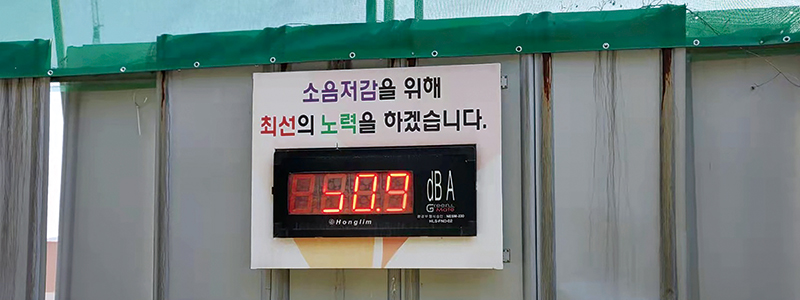 Real-time noise monitoring
We plan, design, and implement environmental pollution prevention systems through preliminary research on soil risks at the site. By doing so, we take steps to protect our ecosystems and communities from potential environmental damage.
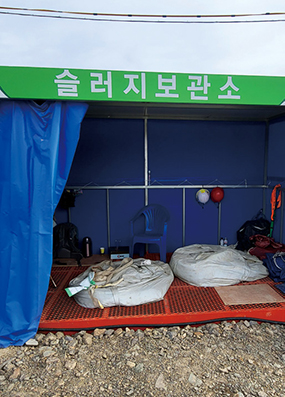 Recycling construction sludge
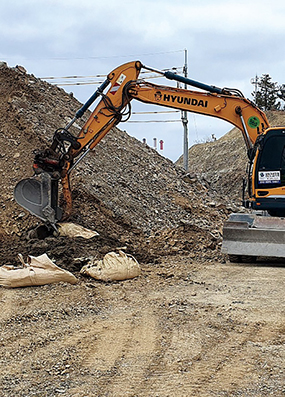 Recycling construction sludge
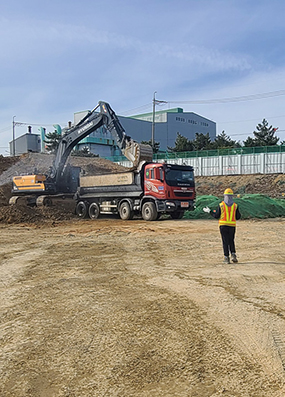 Mobile sprinkler facilities
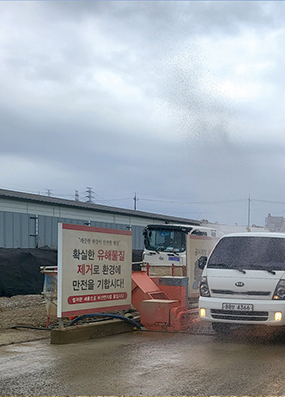 Wheel / car washing facilities
SK ecoengineering strictly applies standards to protect the ecosystem and prevent the loss of biodiversity around the site before construction. Our efforts to protect the ecological environment include removing ecosystem-disturbing plants, transplanting trees, installing small animal escape routes and guiding fences, installing silt protectors, and avoiding nighttime construction work. We also strive to minimize our impact on the ecosystem by raising awareness of the importance of protecting biodiversity among site members and suppliers, and preventing indiscriminate collecting and damaging of wild plants.
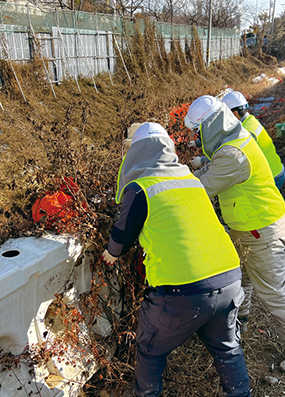 Removing ecosystem-disrupting species
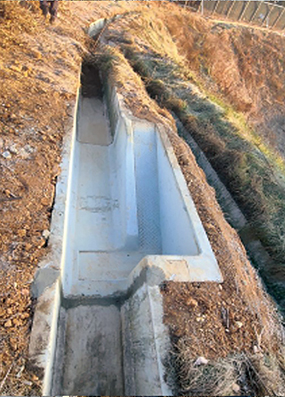 Small animal escape routes
We are developing S.CON (Smart Construction Platform), a DT system capable of collecting environmental information from all sites, including the headquarters, to enable transparent environmental management. We manage environmental data such as GHG emissions, energy consumption, waste discharge, and water consumption at our headquarters and construction sites, and disclose the aggregated data in real time on the S.CON ESG Integrated Dashboard. S.CON is used to manage actions on environmental audits and reports on environmental accidents/issues as well, and we are in the process of developing functions for real-time monitoring of the status and performance of on-site environmental management, including permits, site inspections, and the PEI. We also provide employees with information on environmental management through SK Environmental Management e-guide. Comprising a total of 8 categories and 35 guidelines, including standard guidelines and issue response guidelines, the e-guide provides essential information on on-site environmental management with frequent updates on environmental laws and regulations and the latest data.
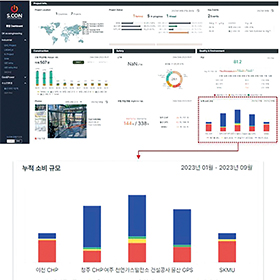 S.CON ESG Integrated Dashboard
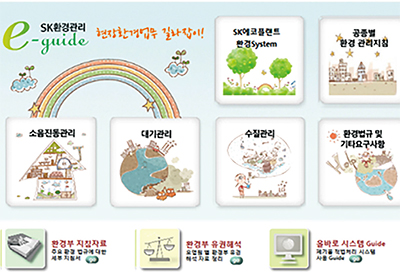 SK Environmental Management e-guide